
The Psychology Behind Tarot Readings: Why Intuitive Readings Feel So Accurate.

Have you ever drawn a tarot card and felt that it described your exact situation? Why does that happen? Is it the cards themselves or is it the particular lens the individual views them through? There’s a reason tarot cards can seem to connect to something inside that you can’t really articulate until you see it laid out in the spread.
How do you see yourself in the cards?
We exist in two forms: the intangible, unseen inner self that is only our thoughts and emotions… things that literally cannot be “seen” from the outside. We then also exist in the concrete, the physically visible and real sensate outer self. Both versions of us are part of who we are. We are not one or the other. We’re both. There is a part of ourselves that only we know that others literally cannot see, or know, unless we make it known to them. And there is the part of us that is under the gaze of another, that we have no control over, that is the result of our literal physical existence in reality. We can’t control the external gaze that also decides who we are. We’re both; we exist in both worlds. And we have to make harmony between them.
So in making sense of the integration of the inner and outer self, what is it that we see in the cards? Are the cards showing the inner self, the outer self, or a combination of the two? When you look at the cards what do you see? The you that you see, or the you that others see looking at you?
That is part of the depth of the tarot- whether or not it conveys to the reader what’s readily seen, or what is only unseen and can only be intuited. It matters how the querent usually interprets themselves; and this is how the reader can come in and change the perspective, seeing from a different lens that the querent is usually used to looking from. The reader may see from the inside or the outside, so what is the difference in the reading if the querent typically chooses the opposite lens?
This is the point of tarot, and the point of having a tarot reader. The reader, who necessarily sees you in a way that is different than you see yourself, may see the outside or the inside relative to how the querent thinks of themselves. If you are prone to seeing yourself from the outside - from the gaze of others - what if the reader is able to nimbly intuit the inside that typically goes missed? If you typically view the external world heavily from the lens of your own perspective without the influence of others, what if the reader can reflect back a vision of how you look from the outside, that you typically discard, that you typically do not view yourself through?
You and the reader could be looking at the same card. And you might interpret from your inner self, while the reader might interpret it from your outer self - and vice versa. How would you know the difference? The reader might, but would you - would you have awareness of both?
A person might have an instinctive reaction to a card: attraction or resistance. Fear, or welcoming - recognition that feels like home or confusion that feels implacable. The cards act as a mirror to the inner self. Inner materials and desires and qualities may be seen purely depending on the individual’s personal biases. At the same time, things that are often defended out of awareness, are feared or avoided, may spring up vividly just through that individual perspective. Things that are brighter, or routinely ignored, influence what is notable about a card. And it’s totally dependent on the person looking at it.
What do you see in a mirror? What do you notice that others don’t, what do you miss that others see? The cards act as that mirror. They give a variety of plateaus, and the difference in the reading is what the eye is drawn to, and the motivation for looking. That is why the tarot is the same deck of cards, viewed by millions of people, but can be interpreted any number of different ways depending on who is doing so and why. The emotional resonance of what’s seen by one person wouldn’t necessarily be glimpsed by another.
So what happens if you look at the cards and you can’t see anything that seems to click? What happens if nothing particularly registers, or particularly stands out?
That doesn’t necessarily mean that you can’t read tarot cards. It might just suggest that you need a little more guidance in terms of how to understand what feels right for you, what feels intuitive for your, if it doesn’t feel natural and true.
That would suggest a difficulty in knowing and symbolizing what things mean for you - and that is the biggest benefit of what a good reader can do: help to make it easier to recognize what doesn’t seem to hit as knowing. That is what the tarot is for - the knowing.

How does tarot intersect with human archetypes?
If you’re familiar at all with psychology, you may have heard of Carl Jung. “Jungian” psychology is known for being more mystical than the accepted, behavioral, action based psychology that is favored in America.
The Tarot operates as a mirror for the psyche — a projection surface where inner content takes symbolic form. When we pull cards, we are not divining the external world so much as perceiving our own unconscious material reflected through archetypal images. Each card becomes a symbolic object that allows subconscious patterns to be recognized, named, and made conscious.
Our minds are wired for pattern recognition. In reading sequences of cards, we naturally impose narrative order, perceiving meaning as intuition fills in the spaces between symbols. This process reveals the Tarot’s psychological depth: it doesn’t create meaning, it reveals the meaning already latent within us. The deck functions as a structured framework through which intuition interprets the unconscious.
Jung’s idea of archetypes — universal symbols rooted in the collective unconscious — helps explain the Tarot’s enduring resonance. These images are not arbitrary; they belong to a shared psychic language spanning cultures and eras. The archetypes embodied in the cards (the Magician, the Empress, Death, the Tower) represent familiar psychological patterns — creation, nurturing, transformation, and disruption — that echo within every human mind.
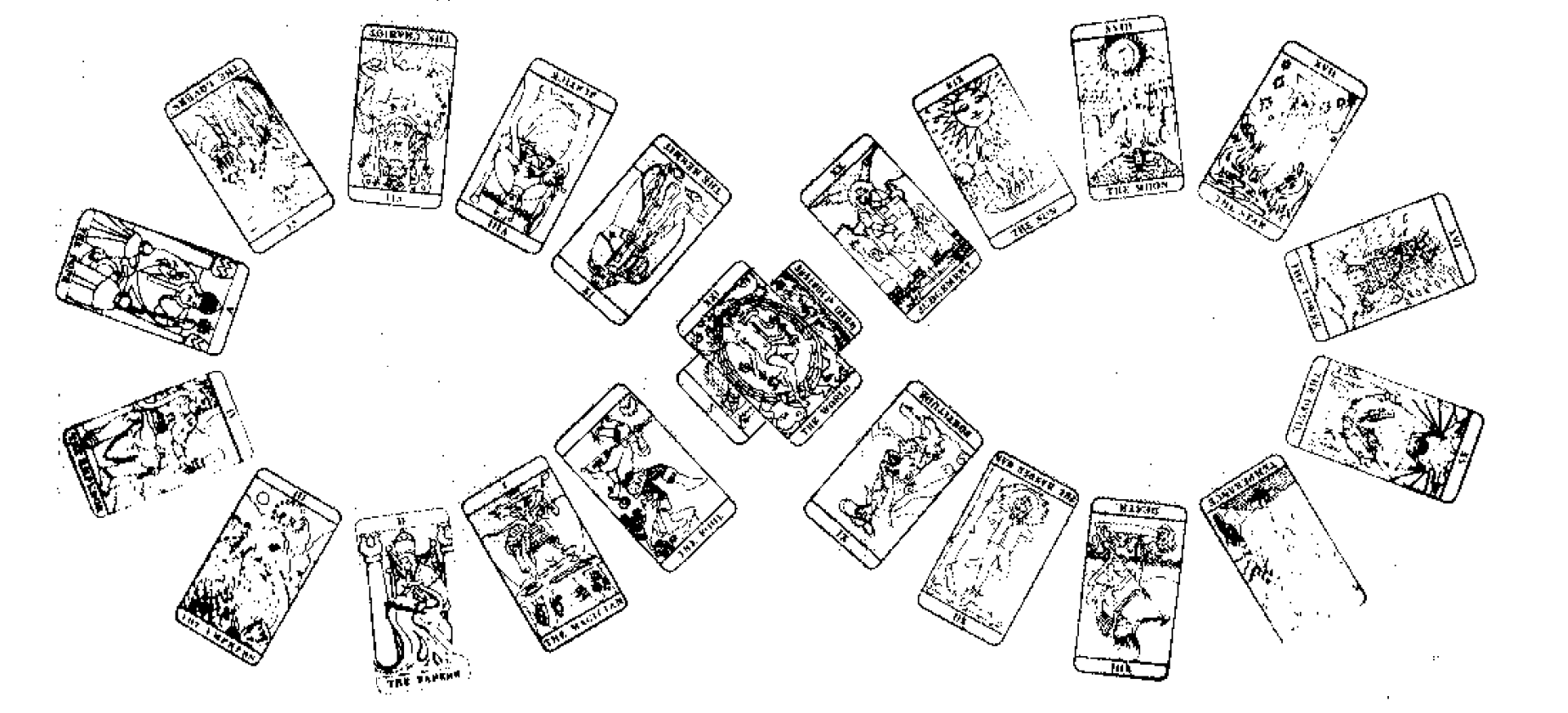
What does this cycle of the Major Arcana mean? Why is it organized this way?
The power of the Tarot, then, is not fortune-telling but self-referencing insight. The cards don’t predict; they prompt reflection. They invite us to question where inner narratives may be shaping our perception of “reality,” distinguishing shared reality from projection or confirmation bias. Through this dialogue between image and intuition, the Tarot becomes a kind of psychic roadmap — a system of universal images that allows for the exploration and integration of both conscious and subconscious knowing.
What does pattern recognition have to do with reading tarot cards?

Is there such a thing as an unbridgeable difference in perspective?
Could it be possible that some people could see things that other people simply can’t?
Is there such a thing as a difference in sight?
What do you think the reason is why there are two types of tarot cards - the Major arcana and the minor arcana? Why make that distinction? What are they different and what’s the purpose of distinguishing that difference?
The tarot deck is meant to convey two things: the larger overarching themes and the things we deal with everyday. The split in the tarot deck represents the great mysteries of life, and the small mysteries of existence. Here is the difference between interest in the tarot and the ability to read the tarot, and this should be taken with deathly seriousness, because this is a truth few would ever give away to tell you:
Some are able to view the world, life, reality, themselves, and others, with a hierarchical verticality. They are able to stack layer upon layer, and fit them all together, and see a larger picture that incorporates not only what is present, but the interactions between all. They are able to organize all that is present in a way that not only accounts for what is but that accounts for the influence and change of all that is.
Others, remain at a more limited, narrow base of perspective, where they can only see horizontally. They must flatten the layers, losing the meaning and the truth of all that is, to minimize and equivocate the nuance and complexity of all that exists. This is not purposeful to either party. Those that can integrate layers do not know they are doing anything unusual. And those that flatten do not know that there is another way of interpreting what they are seeing. It is simply two different ways of existing, and depth of being, that neither can occupy if that is not their natural place of perception. Those that see layered, vertically, have no understanding of a flattened horizontal way of being, and those that are horizontal cannot hold in mind the depth needed to organize the vertical layers.
This is where psychology and the tarot intersect. Because in order to fluidly move between the morals and themes of both the major and the minor arcana, the meaning of the cards both upright and reversed, to hold them all in mind requires a sight that is dimensional, flexible, and temporal in function. This means the individual is able to move forward and backward in time, and able to mirror the present and its opposite simultaneously - able to hold all of those conflicting frames in mind at the same time. This isn’t easy to do, and requires sight that pours outward and deep simultaneously. And frankly, it is simply not the case that anyone or everyone could do so.
That’s the benefit of a good reader. One who can take a card and read it backwards and forwards, inside and out, and upwards and downwards - all at the same time. That requires a great depth of mental processing, and is important to recognize when one has the ability to do so, and when others are limited in doing so. That is the mark of not only having found a good reader, but of having the insight to recognize the difference.
The Major and the minor arcana are layered. They are not flat. One is higher (the major) and one is lower (the minor) - and they should not be understood as equal because they are not, and that is the whole point of distinguishing between the two. The point of seeking an accomplished reader is that they are able to layer the higher and lower in a way that the ultimate message can differentiate what is more significant vs. what can be minimized.
An individual with horizontal perspective will minimize everything, or divest all things of meaning whether some is important and some is not.
That is the danger of viewing the tarot cards from eyes unaccomplished of the hierarchal sight of depth.
Not everyone has it, and that is a truth and fact of psychological functioning. This is why some people are visionaries and some seem unable to see beyond what is right in front of their face.
The depth of the vision matters. And if you struggle to hold all the layers in mind simultaneously…
…it might be a good idea to reach out to a reader who can.